Posts

Showing posts with the label Alzheimer's disease

International Neuroethics Society Annual Meeting Summary: Ethics of Neuroscience and Neurotechnology

Image
By Ian Stevens Ian is a 4th year undergraduate student at Northern Arizona University. He is majoring in Biomedical Sciences with minors in Psychological Sciences and Philosophy to pursue interdisciplinary research on how medicine, neuroscience, and philosophy connect.  At the 2017 International Neuroethics Society Annual Meeting, an array of neuroscientists, physicians, philosophers, and lawyers gathered to discuss the ethical implications of neuroscientific research in addiction, neurotechnology, and the judicial system. A panel consisting of Dr. Frederic Gilbert with the University of Washington, Dr. Merlin Bittlinger , with the Universitätsmedizin Berlin – Charité, and Dr. Anna Wexler with the University of Pennsylvania presented their research on the ethics of neurotechnologies. Dr. Gilbert discussed the cultivation and development of neurotechnologies that use artificial intelligence (AI) to operate brain-computer interfaces (BCI), such as the implanted seizure advisory s...

Getting Out While the Getting's Good

Image
By Dena Davis Dr. Davis is currently at Lehigh University. She taught at Cleveland-Marshall College of Law (Cleveland State University) and Central Michigan University. She received her doctorate in religion from the University of Iowa and her J.D. from University of Virginia. Her specialty is bioethics, and her specific focus is on the ethics of genetic medicine and genetic research. Dr. Davis’ latest book is  Genetic Dilemmas: Reproductive Technology, Parental Choices, and Children’s Futures  (2nd Edition, University of Oxford Press, 2010). Dr. Davis has been a Fulbright scholar in India, Italy, Israel, Indonesia, and Sweden. Dr. Davis serves on the Central Institutional Review Board of the National Cancer Institute , and is a member of the NIH Embryonic Stem Cell Eligibility Working Group. A number of times in the last two years I have been invited to speak about Alzheimer’s disease (AD). The venues have all been academic, but nonetheless have differed widely: South...

How you’ll grow up, and how you’ll grow old

Image
By Nathan Ahlgrim Nathan Ahlgrim is a third year Ph.D. candidate in the Neuroscience Program at Emory. In his research, he studies how different brain regions interact to make certain memories stronger than others. In his own life, he strengthens his own brain power by hiking through the north Georgia mountains and reading highly technical science...fiction. An ounce of prevention can only be worth a pound of cure if you know what to prevent in the first place. The solution to modifying disease onset can be fairly straightforward if the prevention techniques are rooted in lifestyle, such as maintaining a healthy diet and weight to prevent hypertension and type-II diabetes. However, disorders of the brain are more complicated – both to treat and to predict. The emerging science of preclinical detection of brain disorders was on display at Emory University during the April 28th symposium entitled,  “The Use of Preclinical Biomarkers for Brain Diseases: A Neuroethical Dilemma.” ...

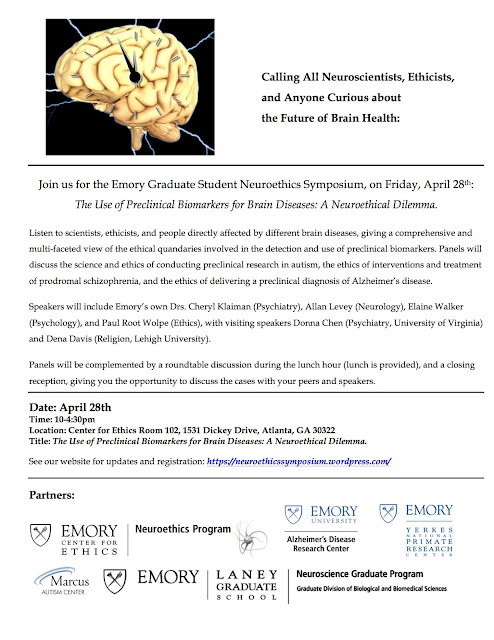
Join us for the Emory Graduate Student Neuroethics Symposium on April 28th, 2017

Image
This spring, the Neuroscience Graduate Program and the Neuroethics Program at Emory University are teaming up to present the 2017 Emory Graduate Student Neuroethics Symposium entitled, The Use of Preclinical Biomarkers for Brain Diseases: A Neuroethical Dilemma.  This year’s symposium will focus on the neuroethics of preclinical detection, including discussions of the basic and clinical research being performed and the neurotechnologies being developed for the early detection of autism, schizophrenia, and Alzheimer’s disease.  The symposium will take place on Friday, April 28th from 10am to 4:30pm at Emory University and is free and open to the public. The symposium will be comprised of three sessions:  Session 1: Autism, with a focus on the ethics of conducting preclinical research. Session 2: Schizophrenia, with a focus on the ethics of interventions and treatment. Session 3: Alzheimer’s disease, with a focus on the ethics of delivering a preclinical diagnosis give...

A Good Death: Towards Alternative Dementia Personhoods

Image
By Melissa Liu Melissa is a Medical Anthropology PhD student at the U. of Washington, Seattle. Her nascent research circles the intersection of neuroscience, dementia, and design. Melissa is also a Neuroethics Fellow with the Center for Sensorimotor Neural Engineering, an NSF ERC.   Something is amiss. Why is there a neighborhood of houses within this assisted living facility? Why do all the houses in the neighborhood have the same 1950s design? Am I standing on carpet? It looks like a garden path. The ceiling feels like a sunset in real time. [ 1 ] Where am I? When is this? The questions above are inspired by Lantern , one of several memory care facilities in Ohio based on a patent-pending memory care program created by Jean Makesh where rehabilitation is the goal [ 2 ] [ 3 ]. However, many more models around the world are based on Reminiscence therapy, a type of therapy which technically has “[no] single definition” but generally “[involves] the recalling of early life events and...

Should Presidential Candidates Be Required to Undergo Preclinical Alzheimer’s Disease Testing?

Image
By Kaitlyn B. Lee Kaitlyn “Kai” Lee is a Project Coordinator in the Center for Medical Ethics and Health Policy at Baylor College of Medicine. She helps to investigate the ethical, legal, and social issues of integrating whole genome sequencing into clinical care as part of MedSeq , a project funded by the NIH’s Clinical Sequencing Exploratory Research ( CSER ) program. Kai earned her BA in Neuroscience from Middlebury College and hopes to continue her education through a joint JD/MPH program . In her op-ed published in the Houston Chronicle, “ Presidential candidates should be tested for Alzheimer’s ,” radio and television personality turned author and keynote speaker Dayna Steele advocates testing presidential candidates for Alzheimer’s disease and releasing their results to the voting public. Steele believes voters have a right to know their future president’s Alzheimer’s test results, as she maintains, “I want to know that the candidate I choose not only supports my priorities bu...