Posts

Showing posts with the label authenticity

The Seven Principles for Ethical Consumer Neurotechnologies: How to Develop Consumer Neurotechnologies that Contribute to Human Flourishing

Image
By Karola Kreitmair  Karola Kreitmair , PhD, is a Clinical Ethics Fellow at the Stanford Center for Biomedical Ethics . She received her PhD in philosophy from Stanford University in 2013 and was a postdoctoral fellow in Stanford’s Thinking Matters program from 2013-2016. Her research interests include neuroethics, especially new technologies, deep brain stimulation, and the minimally-conscious state, as well as ethical issues associated with wearable technology and citizen science.   Brain-computer interfaces, neurostimulation devices, virtual reality systems, wearables, and smart phone apps are increasingly available as consumer technologies intended to promote health and wellness, entertainment, productivity, enhancement, communication, and education. At the same time, a growing body of literature addresses ethical considerations with respect to these neurotechnologies (Wexler 2016; Ienca & Adorno 2017; Kreitmair & Cho 2017). The ultimate goal of ethical consum...
When it comes to issues of identity and authenticity in DBS, let patients have a voice

Image
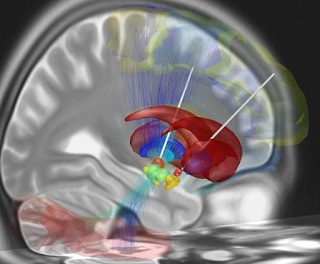
By Ryan Purcell Reconstruction of DBS electrode placement, image courtesy of Wikipedia Deep brain stimulation (DBS) is an extraordinarily popular topic in neuroethics. In fact, you could fill a book with all of the articles written on the subject just in AJOB Neuroscience alone (and the editors have considered doing this!). A special issue on the topic in AJOBN can be found here . Among the most widely discussed neuroethical issues in the DBS arena are concerns over the effects on patient identity and authenticity. But perhaps one perspective that has not been fully represented in the academic literature is that of the patients for whom this is actually their last hope to find a way out of a profound, debilitating and often years-long episode of depression. At February’s Neuroethics and Neuroscience in the News journal club, Dr. Helen Mayberg spoke passionately about the approach that led her team to attempt DBS for major depressive disorder (MDD), the ensuing media response, and ho...

Adderall as a motivational enhancer

Image
Prescription stimulant use is on the rise at college campuses, especially at elite schools where the pressure and demands can be overwhelming. Students have a variety of methods to handle the stresses of their studies, but the consumption of prescription stimulants, such as Adderall or Ritalin, has become more popular among healthy individuals. While this trend raises multiple important ethical issues, the interesting idea that prescription stimulants may be masking authentic versions of ourselves was the topic of the most recent Neuroethics in the News discussion. Facilitated by AJOB Neuroscience editorial intern Ryan Purcell and AJOB Neuroscience Editor John Banja , the discussion centered around a recently published article by Torben Kjaersgaard entitled “Enhancing Motivation by Use of Prescription Stimulants: The Ethics of Motivation Enhancement ."1                       ...