Posts

Showing posts with the label research

Brain devices: Navigating collaborations between industry, government, and researchers

Image
by Paul J. Ford, PhD Dr. Ford is Director of the NeuroEthics Program at the Cleveland Clinic. He is an active clinical ethicist, and teaches ethics to medical students, residents, and fellows. His publications have appeared in Science, The Hastings Center Report, Neurology, Neuromodulation, and Journal of Medical Ethics. He is also a board member for AJOB Neuroscience . This spring (June 3-4, 2015) the National Institutes of Health (NIH) as part of the BRAIN Initiative convened an eclectic group of individuals in hopes of encouraging more investigator initiated studies of currently approved neuromodulation and neuro recording devices for new indications (agenda, session videos, and program goals available here ). The participants, both on the program and in the audience, specifically included industry, researchers, universities, and governmental agencies. I was delighted to participate in the workshop and was impressed by the number of sincerely interested parties across the spect...

Neuroethics in Theory and in Practice: A First-hand Look into the Presidential Commission for the Study of Bioethical Issues

Image
Anyone who turned on CNN this past summer probably remembers the most popular news stories ranging from Obama’s recent efforts to quell political violence in Iraq to Emory University’s admission of two Ebola patients. What was missing from several (if not all of these newscasts), however, was any mention of the continuation of President Obama’s BRAIN initiative right here at Emory University. Specifically, this past June, the Atlanta university welcomed the prestigious Presidential Commission for the Study of Bioethical Issues to confer over many pertinent issues surrounding various ethical and neuroscientific issues. I was lucky enough to be able to attend the session and catch a glimpse of the commission in action. Upon the commission’s completion, I found myself excited while simultaneously confused about the group’s overall mission and decided it would be worthwhile to investigate the Bioethics Commission further. Particularly, I hoped to understand why it is that Obama created a...

Dare to be different: Defense of the research of sex differences

Image
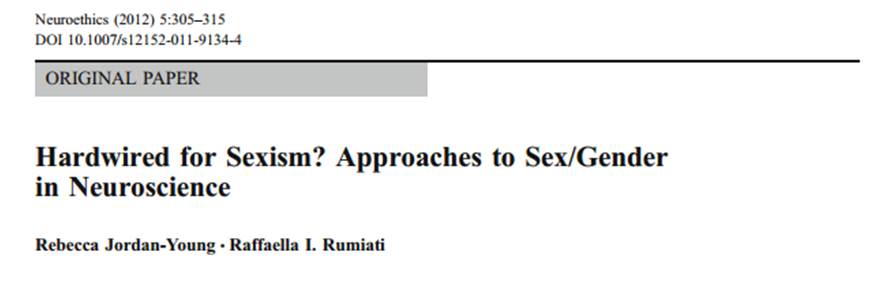
By Guest Contributor, Emory Neuroscience and Animal Behavior Graduate Student Katy Renfro In a recent article published in the journal Neuroethics , Dr. Rebecca Jordan-Young and Dr. Raffaella Rumiati argue that current research on sex differences is “both unscientific and far from politically neutral,” and should be abandoned. [6] This article reflects many of the current conversations on the ethical implications of researching sex differences, which have largely focused on how results of these studies can be misappropriated to support sexist agendas. I cannot argue against the legitimacy of these concerns, and as researchers, we must always be careful to present our findings in a balanced and accurate manner so as to better combat misinterpretations and misrepresentations of data. However, we must also keep in mind that just as science has the potential to influence social and political conversations, this is a bidirectional relationship, and politics also have the power to misinform ...

Animal Models and the Future of Psychiatric Research

Image
"Few medicines, in the history of pharmaceuticals, have been greeted with as much exultation as a green-and-white pill containing 20 milligrams of fluoxetine hydrochloride — the chemical we know as Prozac" wrote Columbia University Assistant Professor of Medicine Siddhartha Mukherjee in a recent New York Times editorial on antidepressant efficacy. As Dr. Mukherjee points out, the rise of antidepressants over the past several decades has been swift and staggering. A recent CDC study found that antidepressants are the most commonly prescribed drug for Americans between 18 and 44 years of age, with 11% of Americans over the age of twelve utilizing such medications. Original image from the Global Information Exchange Network In light of such overwhelming usage rates, one would think that pharmaceutical companies would be falling over themselves to invent the next antidepressant superdrug. As it turns out, however, exactly the opposite trend is emerging. Pharmaceutical giants Ast...

Brain Matters 3 Conference! Values at the crossroads of Neurology, Psychiatry, and Psychology

Image
*Deadline for abstract submissions: May 15, 2012 *  Brain Matters 3:  Values at the Crossroads of Neurology, Psychiatry and Psychology  October 24th-25th, 2012 This conference provides a venue for collaboration and learning in the area of neuroethics. The plenary speakers of this conference will address ethical challenges in the treatment and research for conditions with neurological symptomatology but that are without identifiable biological correlates/causes. The complexities of suffering and disability experienced by individuals with these conditions are significant, including exposure to dangerous and futile treatments. Parallel sessions will include accepted abstracts from a broad range of neuroethics interests.  At this conference, presentations will be given by patients, physicians, neuroscientists, and ethicists and is intended to appeal to a broad audience.  Please see the call for abstracts and conference information at  ...