Posts

Showing posts with the label PTSD

The Neuroethics Blog Series on Black Mirror: Men Against Fire

Image
By Sunidhi Ramesh Image courtesy of Pexels . Humans in the 21st century have an intimate relationship with technology. Much of our lives are spent being informed and entertained by screens. Technological advancements in science and medicine have helped and healed in ways we previously couldn’t dream of. But what unanticipated consequences may be lurking behind our rapid expansion into new technological territory? This question is continually being explored in the British sci-fi TV series  Black Mirror , which provides a glimpse into the not-so-distant future and warns us to be mindful of how we treat our technology and how it can affect us in return. This piece is part of a series of posts that will discuss ethical issues surrounding neuro-technologies featured in the show and will compare how similar technologies are impacting us in the real world.  SPOILER ALERT: The following contains plot spoilers for the Netflix television series,  Black Mirror .  Plot Summary “...

The Neuroethics Blog Series on Black Mirror: White Bear

Image
By Kristie Garza Image courtesy of   Wikimedia Commons. Humans in the 21st century have an intimate relationship with technology. Much of our lives are spent being informed and entertained by screens. Technological advancements in science and medicine have helped and healed in ways we previously couldn’t dream of. But what unanticipated consequences of the rapid expansion into new technological territory? This question is continually being explored in the British sci-fi TV series  Black Mirror, which provides a glimpse into the not-so-distant future and warns us to be mindful of how we treat our technology and how it can affect us in return. This piece is part of a series of posts that discuss ethical issues surrounding neuro-technologies featured in the show and will compare how similar technologies are impacting us in the real world.  *SPOILER ALERT* - The following contains plot spoilers for the Netflix television series Black Mirror.  Plot Summary “White Be...

The [Sea] Monster Inside Me

Image
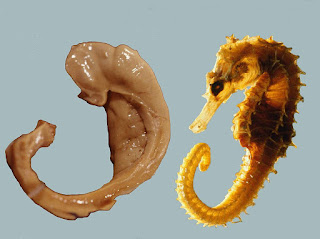
By Sunidhi Ramesh A side-by-side comparison of a sea horse and the human hippocampus (Greek for sea monster ). (Image courtesy of Wikimedia Commons .) In 1587, Venetian anatomist Julius Aranzi gave a name to the intricate, hallmark structure located in the medial temporal lobe of the human brain— the hippocampus , Greek for sea monster . The hippocampus, often said to resemble a sea horse , has since been identified as a key player in the consolidation of information (from short-term memory to long-term memory) and in the spatial memory that allows for our day-to-day navigation. Because of its importance in learning and memory, hippocampal damage is often a culprit in varying forms of dementia, Alzheimer’s disease, short-term memory loss, and amnesia. Since its discovery, the hippocampus has been the subject of extensive research ranging from understanding diet and exercise as cognitive modulators to demonstrating the three-step encoding, storage, and retrieval process that the stru...

VR and PTSD: Healing from trauma by confronting fears in virtual reality environments

Image
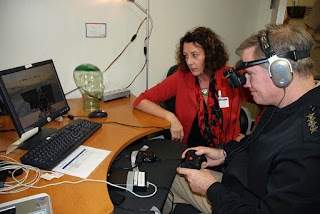
By Katie Givens Kime Image courtesy of Flikr What are the ethical implications of therapeutically re-exposing patients to trauma via virtual reality technologies? Of the 2.7 million American veterans  of the Iraq and Afghanistan wars, at least 20% suffer from depression and/or post-traumatic stress disorder (PTSD) , and other studies peg that percentage even higher. As a chronic, debilitating mental illness, one PTSD symptom is hyperarousal, in which a person repeatedly re-experiences a trauma in the form of nightmares, panic attacks, and flashbacks.  One of the most long-trusted therapeutic approaches to PTSD is exposure therapy; now, virtual reality technology is increasingly being used to simulate exposure to traumatic events and to environments related to the traumatic event. Image courtesy of Flikr Last month’s Neuroethics and Neuroscience in the News event featured the recent research and observations of Barbara O. Rothbaum , who is the Paul A. Janssen Chair in Neurops...

The Stain of the Spotless Mind: Policy Recommendations for Memory Erasure

Image
By Peter Leistikow This post was written as part of a class assignment from students who took a neuroethics course with Dr. Rommelfanger in Paris of Summer 2016. Peter Leistikow is an undergraduate student at Emory University studying Neuroscience and Sociology. When he is not doing research in pharmacology, Peter works as a volunteer Advanced EMT in the student-run Emory Emergency Medical Service. Over the course of 15 years, psychologist Dan McAdams studied how Americans describe their lives. Specifically, McAdams wanted to know what kind of life narratives were associated with lives high in “generativity;” that is, a concern for and commitment to promoting the well-being of future generations. He ultimately discovered that generative adults had narrative identities that emphasized redemption, such as a second chance or delivery from suffering (McAdams 2006). The observation that it might be essential to have overcome adversity, reaping all the lessons and baggage it entails, in ord...