Posts

Showing posts with the label memory modification

The Neuroethics Blog Series on Black Mirror: White Bear

Image
By Kristie Garza Image courtesy of   Wikimedia Commons. Humans in the 21st century have an intimate relationship with technology. Much of our lives are spent being informed and entertained by screens. Technological advancements in science and medicine have helped and healed in ways we previously couldn’t dream of. But what unanticipated consequences of the rapid expansion into new technological territory? This question is continually being explored in the British sci-fi TV series  Black Mirror, which provides a glimpse into the not-so-distant future and warns us to be mindful of how we treat our technology and how it can affect us in return. This piece is part of a series of posts that discuss ethical issues surrounding neuro-technologies featured in the show and will compare how similar technologies are impacting us in the real world.  *SPOILER ALERT* - The following contains plot spoilers for the Netflix television series Black Mirror.  Plot Summary “White Be...

The Neuroethics Blog Series on Black Mirror: The Entire History of You

Image
By Somnath Das Somnath Das recently graduated from Emory University where he majored in Neuroscience and Chemistry. He will be attending medical school at Thomas Jefferson University starting in the Fall of 2017. The son of two Indian immigrants, he developed an interest in healthcare after observing how his extended family sought help from India's healthcare system to seek relief from chronic illnesses. Somnath’s interest in medicine currently focuses on understanding the social construction of health and healthcare delivery. Studying Neuroethics has allowed him to combine his love for neuroscience, his interest in medicine, and his wish to help others into a multidisciplinary, rewarding practice of scholarship which to this day enriches how he views both developing neurotechnologies and the world around him.  Humans in the 21st century have an intimate relationship with technology. Much of our lives are spent being informed and entertained by screens. Technological...

Reading into the Science: The Neuroscience and Ethics of Enhancement

Image
By Shweta Sahu Image courtesy of Pexels . I was always an average student: I was good, just not good enough . I often wondered what my life and grades would be like if I’d had a better memory or learned faster. I remember several exams throughout my high school career where I just could not recall what certain rote memorization facts or specific details were, and now in college, I realize that if I could somehow learn faster, how much time would I save and be able to study even more? Would a better memory have led me to do better on my exams in high school, and would my faster ability to learn new information have increased my GPA? Such has been the question for years now in the ongoing debates of memory enhancement and cognitive enhancement , respectively. I’m not the only student to have ever felt this way and I’m sure I won’t be the last. Technology and medicine seem to be on the brink of exciting new findings, ones that may help us in ways we’ve never before thought imaginable. Th...

The [Sea] Monster Inside Me

Image
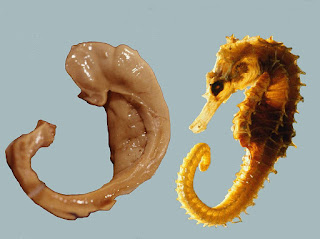
By Sunidhi Ramesh A side-by-side comparison of a sea horse and the human hippocampus (Greek for sea monster ). (Image courtesy of Wikimedia Commons .) In 1587, Venetian anatomist Julius Aranzi gave a name to the intricate, hallmark structure located in the medial temporal lobe of the human brain— the hippocampus , Greek for sea monster . The hippocampus, often said to resemble a sea horse , has since been identified as a key player in the consolidation of information (from short-term memory to long-term memory) and in the spatial memory that allows for our day-to-day navigation. Because of its importance in learning and memory, hippocampal damage is often a culprit in varying forms of dementia, Alzheimer’s disease, short-term memory loss, and amnesia. Since its discovery, the hippocampus has been the subject of extensive research ranging from understanding diet and exercise as cognitive modulators to demonstrating the three-step encoding, storage, and retrieval process that the stru...