Posts

Showing posts with the label Emory University

A Special Event Reprise: Exploring the Ethics of Cognitive Enhancement and the University's Policy at Emory
Image
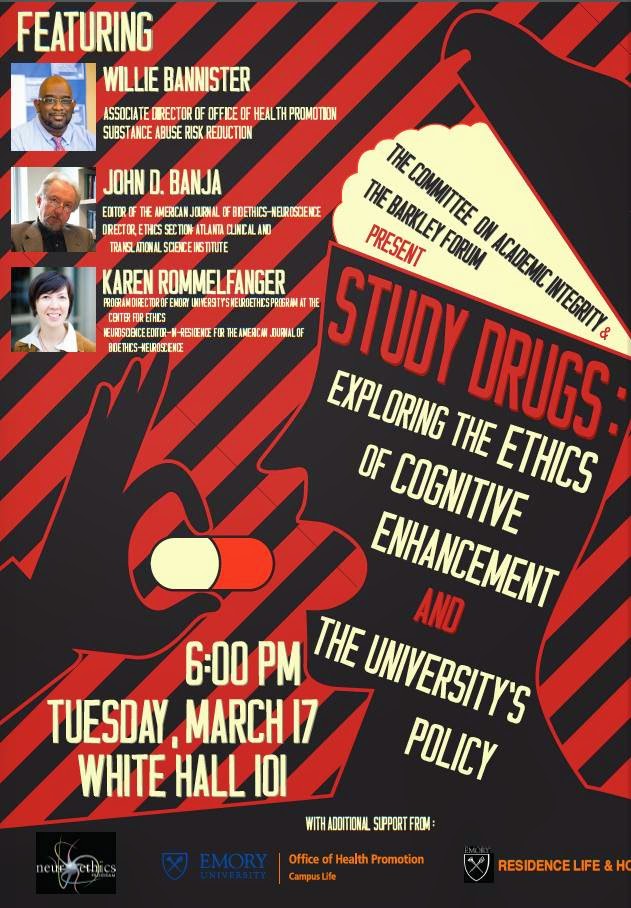
Last month, Emory’s Committee on Academic Integrity and the Barkley Forum collaborated to host “Study Drugs: Exploring the Ethics of Cognitive Enhancement and the University’s Policy.” The program featured a debate among four Emory University undergraduates and a discussion between Emory Center for Ethics's very own Dr. Karen Rommelfanger and Dr. John Banja  in addition to Willie Bannister , Emory’s Associate Director of Health Promotion. This event, organized by Emory University senior Grant Schleifer, brought out students from many areas of study to weigh in on how the university can better address the potential issue of increasing usage of cognitive enhancement drugs within Emory’s student body. In an effort to relay the contents of the event to the greater student body, the speeches from the event are displayed below in the order of their presentation. This 20-minute debate included two affirmative speeches advocating that Emory ought to take a stance on the use of cognitive ...
Neuroethics in Theory and in Practice: A First-hand Look into the Presidential Commission for the Study of Bioethical Issues

Image
Anyone who turned on CNN this past summer probably remembers the most popular news stories ranging from Obama’s recent efforts to quell political violence in Iraq to Emory University’s admission of two Ebola patients. What was missing from several (if not all of these newscasts), however, was any mention of the continuation of President Obama’s BRAIN initiative right here at Emory University. Specifically, this past June, the Atlanta university welcomed the prestigious Presidential Commission for the Study of Bioethical Issues to confer over many pertinent issues surrounding various ethical and neuroscientific issues. I was lucky enough to be able to attend the session and catch a glimpse of the commission in action. Upon the commission’s completion, I found myself excited while simultaneously confused about the group’s overall mission and decided it would be worthwhile to investigate the Bioethics Commission further. Particularly, I hoped to understand why it is that Obama created a...

June 9th and 10th: President's Commission for the Study of Bioethical Issues at Emory University

Image
The Presidential Commission for the Study of Bioethical Issues is an advisory panel that counsels the President on bioethical issues in light of scientific and medical advances. Most recently, the panel published Gray Matters: Integrative Approaches for Neuroscience, Ethics, and Society as a part of the Brain Research through Advancing Innovative Neurotechnologies (BRAIN) Initiative . This document touched on relevant ethical issues related to neuroscience and made recommendations for integrating ethics into various facets of neuroscience research, education, and policy making. On June 9–10, 2014, a public meeting of the President’s Commission for the Study of Bioethical Issues will be taking place at Emory University in the Rollins School of Public Health Building. The complete agenda is listed here , but the Commission will discuss the BRAIN Initiative and current work taking place in the field of neuroscience. Watch the live webcast and follow AJOB Neuroscience on Twitter if yo...

Now Available! Bias in the Academy Pre-Symposium Series Archives on YouTube

Image
This year's Neuroethics Symposia , a partnership of Emory's Neuroscience Graduate Program, Laney Graduate School and the Emory Center for Ethics Neuroethics Program, is designed to discuss the complex influence of stereotype/bias on academia and apply advances in the science of stereotype bias to university policies and practices. Through a pre-symposia seminar series and symposia, a white paper will be produced to highlight challenges and to put forth practical solutions to move toward mitigating the detrimental influence of bias and stereotyping in academia. The first of four pre-symposium seminars was led by neuroscience graduate student, Jacob Billings.  The video of this seminar is available below. An Introduction to Bias: A Social Network Primer   Jacob Billings, Neuroscience graduate student, Emory University  Stay tuned for more videos! The next seminar series will be led by Chris Martin, a sociology graduate student at Emory University. He discussion is entitled,...

Welcome Our Newest Neuroethics Scholar!

Image
It is with great pleasure that the Emory Neuroethics Program announces its newest neuroethics scholar : Riley Zeller-Townson! The Neuroethics Program invited graduate students to create and to join collaborative, interdepartmental faculty teams at Emory and in the Atlanta community to pursue Neuroethics scholarship.  Graduate students were free to propose projects of interest to them. Proposals included innovative ideas in the arena of teaching, empirical research, new media, and beyond. By the completion of their one year appointments, each scholar is expected to co-author a paper and present his or her work.  The selection process was quite competitive. The abstract of Riley’s proposed project and a short bio can be found below. Riley Zeller-Townson (Neuroethics and Art) Riley Zeller-Townson For my Neuroethics Scholars Program Fellowship, I will be studying, as well as participating in, the interaction between Neuroethics and Art.  This includes documenting and ana...

Frontiers in Neuroscience, January 27th, 2011: Emory's Dr. Elaine Walker on "Neurodevelopmental Mechanisms in the Emergence of Psychosis"

Image
Psychotic disorders like schizophrenia affect about 5% of people and often result in life-long disability. Identifying at-risk individuals and predicting disease onset are crucial, and present a challenge to the development of preventative treatments. Understanding the biological mechanisms underlying psychosis are also extremely important in identifying risk factors and designing treatments. Because psychotic disorders are so disabling and usually irreversible, research interests in this field have shifted toward prevention and early intervention. Subtle pre-clinical deficits in psychosocial and neurocognitive functioning have been reported for many years and are now being extensively studied. Elucidating this pre-illness state, known as the “prodromal” period, is one area of research for Dr. Elaine Walker, the Samuel Candler Dobbs Professor of Psychology and Neuroscience at Emory University. Dr. Walker spoke at the Frontiers in Neuroscience Seminar Series on Friday, January 27 th , ...

Second Installment: First Year, Neuroscience Students at Emory Write About Neuroethics of the Brain and Violence

Image
This year, Emory's First Year Neuroscience Graduate Students were asked to write a blog post for the Neuroethics portion of their Neuroscience and Communications Course. These posts will be delivered in 4 weekly installments, each week featuring a commentary on a different neuroethics piece. This is the second of four installments. This week, we feature blogs covering the following article: Decline of violence: Taming the devil within us by Steven Pinker Nature 478, 309-311 (2011) SOURCE: M. EISNER CRIME JUSTICE 30 , 83–142 (2003) Want to cite this post? Rommelfanger, K. (2011). Second Installment: First Year, Neuroscience Students at Emory Write About Neuroethics of the Brain and Violence. The Neuroethics Blog. Retrieved on , from http://www.theneuroethicsblog.com/2011/12/second-installment-first-year.html

Welcome Our Inaugural Neuroethics Scholars!

Image
It is with great pleasure that the Emory Neuroethics Program announces its inaugural neuroethics scholars!  The Neuroethics Program invited graduate students to create and to join collaborative, interdepartmental faculty teams at Emory and in the Atlanta community to pursue Neuroethics scholarship.  Graduate students were free to propose projects of interest to them. Proposals included innovative ideas in the arena of teaching, empirical research, new media, and beyond. By the completion of their one year appointments, each scholar is expected to co-author a paper and present his/her work.  The selection process was quite competitive. Abstracts of their proposed projects can be found below. Cyd Cipolla and Kristina Gupta (Innovative Neuroethics Teaching) Cyd Cippola and Kristina Gupta We both work in the field of feminist science studies, a field that has challenged the gender biases of scientific knowledge. In her dissertation research, Cyd examines the role of religious...

Neuroethics Recommended Awesome Reading (RAWR)!: Neuroethics, Gender and the Response to Difference

Image
The Neuroethics Blog first installment of RAWR (Recommended AWesome Reading) features an article by Emory's own Dr. Deboleena Roy. Deboleena Roy Dr. Deboleena Roy is an Associate Professor of Women's Studies and Neuroscience & Behavioral Biology. Dr. Roy's academic interests and background are exquisitely interdisciplinary. Trained as a neuroendocrinologist and molecular biologist, Dr. Roy uses her perspective as a neuroscientist to explore dimensions of feminist theory and feminist ethics. Her recent article published in the journal Neuroethics is titled, "Neuroethics, Gender and the Response to Difference." In this article, Dr. Roy invites readers to examine how neuroscience data, particularly data emerging from studies utilizing brain imaging, are informing larger conversations about sex and/or gender differences. Science often benefits from having the luxury of moral authority, but Dr. Roy's article reminds us that neuroscience and scientific resea...