Posts

Showing posts with the label virtual reality

The Neuroethics Blog Series on Black Mirror: Virtual Reality

Image
By Hale Soloff Hale is a Neuroscience PhD student at Emory University. He aims to integrate neuroethics investigations with his own research on human cognition. Hale is passionate about science education and public science communication, and is pursuing a career in teaching science.  Humans in the 21st century have an intimate relationship with technology. Much of our lives are spent being informed and entertained by screens. Technological advancements in science and medicine have helped and healed in ways we previously couldn’t dream of. But what unanticipated consequences may be lurking behind our rapid expansion into new technological territory? This question is continually being explored in the British sci-fi TV series Black Mirror , which provides a glimpse into the not-so-distant future and warns us to be mindful of how we utilize our technology and how it can affect us in return. This piece is the first in a series of posts that will discuss ethical issues surrounding neuro-...
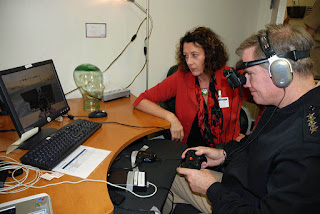
VR and PTSD: Healing from trauma by confronting fears in virtual reality environments

Image
By Katie Givens Kime Image courtesy of Flikr What are the ethical implications of therapeutically re-exposing patients to trauma via virtual reality technologies? Of the 2.7 million American veterans  of the Iraq and Afghanistan wars, at least 20% suffer from depression and/or post-traumatic stress disorder (PTSD) , and other studies peg that percentage even higher. As a chronic, debilitating mental illness, one PTSD symptom is hyperarousal, in which a person repeatedly re-experiences a trauma in the form of nightmares, panic attacks, and flashbacks.  One of the most long-trusted therapeutic approaches to PTSD is exposure therapy; now, virtual reality technology is increasingly being used to simulate exposure to traumatic events and to environments related to the traumatic event. Image courtesy of Flikr Last month’s Neuroethics and Neuroscience in the News event featured the recent research and observations of Barbara O. Rothbaum , who is the Paul A. Janssen Chair in Neurops...

Now Available! Neuroethics Journal Club Video Archives on YouTube

Image
The Neuroethics Journal Club videos are now available on YouTube. Watch each discussion to learn about a variety of neuroethics issues, from treatments for pedophilia to neural plasticity in mice. For each video, one presenter introduced the journal topic and opened discussion to the audience.  Neuroethics Journal Club : The Sexed Brain The Sexed Brain: Between Science and Ideology Catherine Vidal, Neuroethics, 2012  Abstract : Despite tremendous advances in neuroscience, the topic “brain, sex and gender” remains a matter of misleading interpretations, that go well beyond the bounds of science. In the 19th century, the difference in brain sizes was a major argument to explain the hierarchy between men and women, and was supposed to reflect innate differences in mental capacity. Nowadays, our understanding of the human brain has progressed dramatically with the demonstration of cerebral plasticity. The new brain imaging techniques have revealed the role of the environme...