Posts

Showing posts with the label children

The Ethics of Using Brain Stimulation to Enhance Learning in Children

Image
By Peter Leistikow This post was written as part of a class assignment from students who took a neuroethics course with Dr. Rommelfanger in Paris in Summer 2016. Peter Leistikow is an undergraduate student at Emory University studying Neuroscience and Sociology. When he is not doing research in pharmacology, Peter works as a volunteer Advanced EMT in the student-run Emory Emergency Medical Service.  Ever since the advent of electricity, people have tried to harness this power for therapeutic purposes. Nineteenth century posters touted the benefits of “self-applicable curatives for nervous, functional, chronic, and organic diseases” in the form of electric belts and harnesses (Browne 2014). Although these items are historical curiosities today, scientists are still trying to harness the potential benefits of electricity, especially in the treatment of psychiatric and learning disorders. Transcranial direct current stimulation ( TDCS ) is a non-invasive experimental procedure that u...


Responsibility: Revis(ion)ing brains via cognitive enhancement

Image
By Shweta Sahu The Statue of Liberty, an iconic symbol of American opportunity; courtesy of Wikipedia Most every parent wants their child to grow up to be a neurosurgeon, a lawyer, or the next gen Mark Zuckerberg . That was especially true in my case, as a first generation child. When I was two, my parents came to the United States, "the land of opportunity," seeking the success that they had only heard about in India. I grew up hearing their stories of hardship when they first moved here with an infant, without a car, without any extended family, and knowing very little working English. I witnessed them struggle tirelessly to make a life for themselves and they always said that without education you are nothing and will be no one. As a child, while my friends would go to sleepovers and camping trips with friends, my dad would spend time checking my math problems on the white board at home and my mom would make me spell 50 words correctly every night. But even with all that p...

The freedom to become an addict: The ethical implications of addiction vaccines

Image
by Tabitha Moses  Tabitha Moses, M.S., is Administrative and Research Coordinator at Lehman College, CUNY, as well as a Research Affiliate at the National Core for Neuroethics at the University of British Columbia. Tabitha earned her BA in Cognitive Science and Philosophy and MS in Biotechnology from The Johns Hopkins University. She has conducted research in the areas of addiction, mental illness, and emerging neurotechnologies. She hopes to continue her education through a joint MD/PhD in Neuroscience while maintaining a focus on neuroethics. The introduction of “addiction vaccines” has brought with it a belief that we have the potential to cure addicts before they have ever even tried a drug. Proponents of addiction vaccines hold that they will: prevent children from becoming addicted to drugs in the future,  allow addicts to easily and safely stop using drugs, and  potentially lower the social and economic costs of addiction for society at large. However, it is cri...

“Believe the children”? Childhood memory, amnesia, and its implications for law

Image
How reliable are childhood memories? Are small children capable of serving as reliable witnesses in the courtroom? Are memories that adults recall from preschool years accurate? These questions are not only important to basic brain science and to understanding our own autobiographies, but also have important implications for the legal system. At the final Neuroscience, Ethics and the News journal club of the 2014 Fall semester, Emory Psychologist Robyn Fivush led a discussion on memory development, childhood amnesia, and the implications of neuroscience and psychology research for how children form and recall memories. This journal club discussion was inspired by a recent NPR story that explored the phenomenon of childhood amnesia. Why is it that most of us cannot form long-term memories as infants, at least in the same way that we can as adults? This fundamental question has fascinated many researchers and psychologists and neuroscientists today are tackling it in innovative ways. E...

Beyond polemics: science and ethics of ADHD (critique by Yan Hong)

Image
Attention-deficit hyperactivity disorder (ADHD) is one of the most common childhood psychiatric disorders in the world. Its main symptoms consist of inattention (be easily distracted, miss details, and frequently switch from one activity to another or have difficulty organizing and completing a task or learning something new or trouble completing homework assignments), hyperactivity and impulsiveness (fidget and squirm in their seats or talk nonstop or be very impatient) 1 . These symptoms emerge mainly before seven-year old and approximately 75% of those children are male 2,3 . Two criteria are currently used to diagnose ADHD, Diagnostic and Statistical Manual of Mental Disorders, 4th Edition (DSM-IV) and International Classification of Diseases, 10th edition (ICD-10). American psychiatrists follow the DSM-IV, which describes two primary categories of behavioral symptoms: inattention and impulsivity-hyperactivity; and three subtypes of ADHD: inattentive type, hyperactive-impulsive typ...

Beyond polemics: science and ethics of ADHD by Illna Singh (critique by Maylen Perez)

Image
Over the past decade or so, there has been an alarming growth in the number of ADHD diagnoses, and, which is more disturbing, the prescription of stimulants for children with this condition. Concurrent with these increases has been a growing concern in the general public about the legitimacy of ADHD as a real disease and the repercussions and ethical issues of giving kids psychotropic drugs. A hundred years back, this was not a problem. Kids would come to class, be disruptive, not listen, misbehave… and get a whopping smack in the hand or bum with some kind of discipline ruler or other blunt object. The teacher found this behavior to be typical of kids, the parents shook their heads wondering “where did we go wrong?” and life went on. Today, however, there have been striking advances in science that have given us some insight into the factors that contribute to ADHD, tools for recognizing the symptoms of this disease, and yet others for treating it. Or so it seems. Do we indeed ...

Stimulant Treatment of ADHD in Children

Image
There are many ethical concerns that are raised by the treatment of children with psychotropic drugs. This is especially relevant with the use of stimulants to treat ADHD because of the large number of children receiving stimulant medication. In 2008, 3.5% of children under 18 in the United States received stimulant medication. This was even higher in school age children and adolescents, with 5.1% of 6-12 year olds and 4.9% of 13-18 year olds receiving stimulant treatment. This data indicates that an estimated 2.8 million children received stimulant medication for the treatment of ADHD in 2008 1 . Are stimulants overused? ( Source ) The safety of stimulant medications in children is a large concern because there have not been many longitudinal studies on the effects of stimulant usage, especially for children beginning stimulant usage at a young age. There has been some evidence of serious side effects, including cardiovascular risk, growth suppression, and development or early onset ...

Diagnosed with a bad case of growing up poor?

Image
What if how wealthy your parents were before you were born and while you were developing changed who you are, how smart you are and how well you are going to do in life? Well, it turns out that your socioeconomic status during development really does affect your life that dramatically. In a recent review by Meany et al. the authors discuss how different aspects of low socioeconomic status affect childhood development. In the first part of this blog post I will discuss the findings of this article and in the second I will discuss the ethical issues of discussing this type of human condition as a disease. Socioeconomic status' influence on development ( source ) According to Meany et al. socioeconomic status has wide ranging and influential effects on the developmental outcomes of childhood development. These effects may be accounted for by three quantifiable variables: access to quality prenatal care, the quality of parental care, and the quality of stimulation from the home en...

Psychostimulants in preschoolers: Panacea or Pandora's Box?

Image
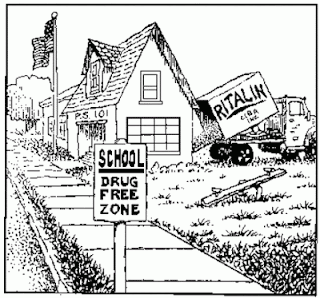
Victoria became pregnant at a young age. During her pregnancy, she was unable to consistently make responsible choices for herself and her developing child, often indulging in alcohol and drugs. As a result, her son Brian was born prematurely at 7 months. By the time Brian entered preschool, he became increasingly difficult for Victoria and his teachers to control, his interactions with other children at times violent and aggressive. Desperately trying to manage Brian’s outbursts, Victoria confides in a child psychiatrist who puts Brian on Ritalin. Within a couple of months, Brian’s outbursts subside, and much to everyone’s relief (Brian’s included), he is now able to sit through his preschool classes with limited distraction. He begins to enjoy relating with other kids and no longer receives negative attention at school. Several years later, Brian, now a very diminutive 9 year-old, writes a paper for a class assignment in which he suggests that everyone should have treatm...