Posts

Showing posts with the label Steven Hyman

Neuroethics Journal Club: Hooked on Vaccines

Image
Imagine a vaccine that causes our immune system to create antibodies against a drug like cocaine. After being vaccinated, we could snort cocaine and the antibodies would sequester the drug before it could reach our brain. A recent article in Nature Immunology’s Commentary section, “Immune to Addiction” , considers the ethical implications of such vaccines. We discussed the article at December's meeting of the Neuroethics Journal Club, led by Emory Neuroscience graduate student, Jordan Kohn. Jordan Kohn: his provocative Powerpoint for journal club momentarily made me think I was an anti-vaxxer Here's what I took away from this month's meeting: we need to integrate the different ways we study addiction. You might wonder what the ways we study substance abuse have to do with a vaccine against it. As the authors of the article say, "How substance dependence is characterized and classified informs the appropriateness of strategies aimed" at preventing or treating it. I...

Neurodiversity and autism: where do we draw the line?

Image
In April 2012, the Emory Neuroethics Program conducted an interview with Steven Hyman , the director of the Stanley Center for Psychiatric Research at MIT’s Broad Institute, where he expressed his belief that mental illnesses and developmental disorders should not be thought of as clear and distinct categories. He said that “classifications are, in the end, cognitive schemata that we impose on data in order to organize it and manipulate it…it's really not helpful to act like there's a ‘bright line’ in nature that separates the well from non-well.” Rather, he said, there are spectrums of behaviors, and disorders exist along them with differing degrees of severity. This idea of spectrum disorders is common in modern psychiatry, with a commonly known example being the autism spectrum. This approach groups similar disorders of varying levels of severity along a spectrum which also includes behaviors and emotions classified as normal. While the spectrum approach is often touted a...

My Brain Made Me Do It

Image
As a college student deep into my studies, I have developed a dependency on a warm, slightly sweetened morning cup of coffee. I begin each day (or sometimes each afternoon) with a mug full of the deep brown nectar, with its bold, slow roasted flavor. I suppose I could quit any time I want, right? You know, I could put the cup down and be the same. Maybe I would have a harder time getting started in the morning or be less productive at work. It might be a little more challenging to stay awake on my drive to campus. Maybe I’ll go to bed a little earlier and put off my assignments for another day. On second thought, maybe I’ll stick to my coffee. I don’t think I could do much without it. Original Image from Americannonfiction.com With the knowledge that I am far from being the only one with this compulsion, I want to open the discussion on addiction and responsibility. Getting started on ‘something,’ such as drugs, gambling--some are now suggesting even the Internet--is generally consider...

What’s in a Name?: DSM Criteria and Addiction

Image
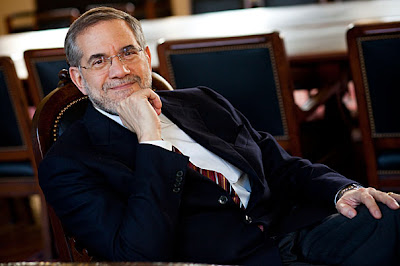
“What’s in a name? That which we call a rose, by any other name would smell as sweet.” This is the famous question posed by Juliet in the immortalized balcony scene.  And while Shakespeare could afford to question the idea, patients with mental disorders, scientists who study the disorders, and the insurance agents that fund the aid have not yet found a way to do without names. In a recent interview, Steven Hyman puts this sentiment in his own words: “Classifications are, in the end, cognitive schemata that we impose on data in order to organize and manipulate it. Many disorders are better represented for scientific purposes, but also for setting rational thresholds for treatments as continuous quantitative dimensions.” Image of Dr. Hyman: http://news.harvard.edu/gazette/story/2010/12/hyman_release/ Coinciding with the 2nd Annual Neuroethics Award , several staff members of Emory’s Center for Ethics interviewed Dr. Steven Hyman , the esteemed Director of the Broad Institute S...

Animal Models and the Future of Psychiatric Research

Image
"Few medicines, in the history of pharmaceuticals, have been greeted with as much exultation as a green-and-white pill containing 20 milligrams of fluoxetine hydrochloride — the chemical we know as Prozac" wrote Columbia University Assistant Professor of Medicine Siddhartha Mukherjee in a recent New York Times editorial on antidepressant efficacy. As Dr. Mukherjee points out, the rise of antidepressants over the past several decades has been swift and staggering. A recent CDC study found that antidepressants are the most commonly prescribed drug for Americans between 18 and 44 years of age, with 11% of Americans over the age of twelve utilizing such medications. Original image from the Global Information Exchange Network In light of such overwhelming usage rates, one would think that pharmaceutical companies would be falling over themselves to invent the next antidepressant superdrug. As it turns out, however, exactly the opposite trend is emerging. Pharmaceutical giants Ast...

Refried serotonin lunch

Image
That title sounds like the prequel to a William Burroughs novel. I wish I'd come up with it myself, but I'm actually plagiarizing almost word for word from Dr. Steven Hyman, Director of the Stanley Center for Psychiatric Research at the Broad Institute of MIT and Harvard. Last week, Emory awarded Dr. Hyman this year's Neuroscience and Ethics Award. Dr. Hyman spoke on "Addiction as a Window on Volitional Control", which shouldn't be surprising, given his molecular and genetic studies of the dopaminergic system. Earlier in the day, Dr. Hyman stopped by the Emory Center for Ethics to have lunch with faculty and students from several schools and programs. He held forth on the state of translational neuropsychiatric research for an hour and a half, while the rest of us prevented him from eating by constantly barraging him with questions. I have a feeling I'm not the only one who found what he had to say both thought-provoking and provocative. He liberally spice...

Save the date! Neuroscience and Ethics Award on April 9th goes to Dr. Steven Hyman

Image
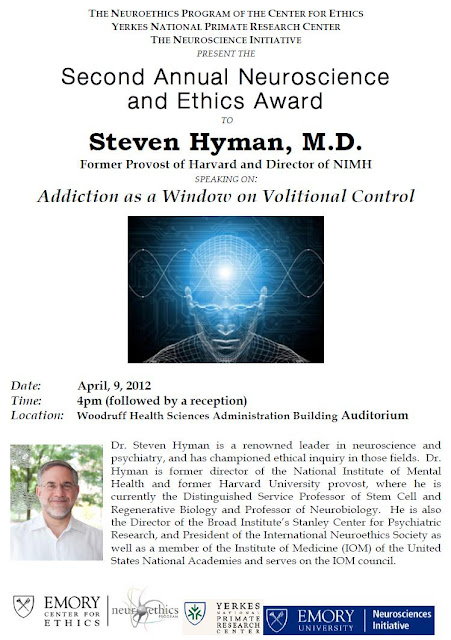
You won't want to miss the Second Annual Neuroscience and Ethics Award!  We are proud to announce this year's award will go to Dr. Steven Hyman. T HE N EUROETHICS P ROGRAM OF THE C ENTER FOR E THICS Y ERKES N ATIONAL P RIMATE R ESEARCH C ENTER T HE N EUROSCIENCE I NITIATIVE PRESENT THE Second Annual Neuroscience and Ethics Award TO Steven Hyman, M.D. Former Provost of Harvard and Director of NIMH SPEAKING ON : Addiction as a Window on Volitional Control Date: April, 9, 2012 Time: 4pm (followed by a reception) Location:  Woodruff Health Sciences Administration Building  Auditorium Dr. Steven Hyman is a renowned leader in neuroscience and  psychiatry, and has championed ethical inquiry in those fields. Dr.  Hyman is former director of the National Institute of Mental  Health and former Harvard University provost, where he is currently the Distinguished Service Professor of Stem Cell and  Regenerative Biology and Professor of Neurobiology. He is ...