Posts

Showing posts with the label locked-in syndrome

Neuroprosthetics for Speech and Challenges in Informed Consent

Image
By Hannah Maslen  Hannah Maslen is the Deputy Director of the Oxford Uehiro Centre for Practical Ethics , University of Oxford. She works on a wide range of topics in applied philosophy and ethics, from neuroethics to moral emotions and criminal justice. Hannah is Co-PI on BrainCom, a 5-year European project working towards the development of neural speech prostheses. Here, she leads the work package on ‘Ethics, Implants and Society’.   Scientists across Europe are combining their expertise to work towards the development of neuroprosthetic devices that will restore or substitute speech in patients with severe communication impairments. The most ambitious application will be in patients with locked-in syndrome who have completely lost the ability to speak. Locked-in syndrome is a condition in which the patient is awake and retains mental capacity but cannot express himself or herself due to the paralysis of afferent motor pathways, preventing speech and limb movements (ex...
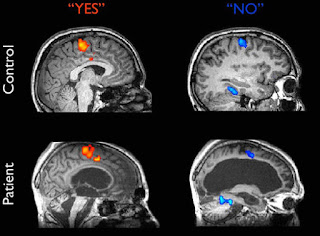
Ethics, Logic and Vegetative States on a First Date

Image
So, you’re on a first date and you’ve just finished discussing your favorite movies, how many siblings you have et cetera. The next natural topic of discussion will be “how do you feel about functional neuroimaging of the vegetative state?” Don’t be intimidated. Here are three guidelines to follow so that your discussion is intellectually stimulating and does not get stuck in a mire of cognitive biases and gaps in logic. fMRI Communication? ( Source ) Avoid the Availability Heuristic: Your date has most likely read over Owen and Coleman’s 2008 review of functional MRI’s ability to upgrade patients from vegetative states to non-behavioral minimally conscious states (Owen and Coleman 2008). It would be impossible for both of you not to think about the 43% chance of misdiagnosis if you’re in a vegetative state (Owen and Coleman 2008). Telling him/her that more recent studies have decreased these misdiagnoses to 41% probably won’t help (Schnakers 2009) It’s important to remember that just...