The [Sea] Monster Inside Me
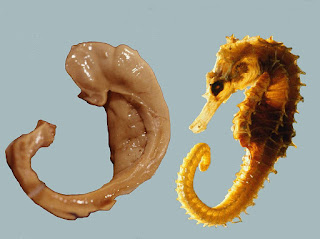
By Sunidhi Ramesh A side-by-side comparison of a sea horse and the human hippocampus (Greek for sea monster ). (Image courtesy of Wikimedia Commons .) In 1587, Venetian anatomist Julius Aranzi gave a name to the intricate, hallmark structure located in the medial temporal lobe of the human brain— the hippocampus , Greek for sea monster . The hippocampus, often said to resemble a sea horse , has since been identified as a key player in the consolidation of information (from short-term memory to long-term memory) and in the spatial memory that allows for our day-to-day navigation. Because of its importance in learning and memory, hippocampal damage is often a culprit in varying forms of dementia, Alzheimer’s disease, short-term memory loss, and amnesia. Since its discovery, the hippocampus has been the subject of extensive research ranging from understanding diet and exercise as cognitive modulators to demonstrating the three-step encoding, storage, and retrieval process that the stru...