Posts

Showing posts with the label Book Review

A Review of Gut Feminism

Image
By Katie Givens Kime Katie Givens Kime is a doctoral student at Emory University in the Graduate Division of Religion , as well as the Center for Mind, Brain and Culture , and the Psychoanalytic Studies Program. Her dissertation investigates the role of religious conceptions in addiction recovery methods. As neuroscience has expanded in capacity, resources, and public attention, many in the social sciences and humanities have been loudly critical: “Reductionism! Neurobiological chauvinism!” The essence of such critique is that the objectivity championed by the sciences masks all sorts of hidden biases, unconscious agendas, political motivations and economic purposes. Many historians and philosophers of science have argued that even choosing the object of scientific study and communicating observations inevitably involves language, point-of-view, and value prioritization. This means the nature of scientific knowledge, to an important degree, is unavoidably sociocultural [1]. Femini...

AI and the Rise of Babybots: Book Review of Louisa Hall’s Speak

Image
By Katie Strong, PhD “Why should I be punished for the direction of our planet’s spin? With or without my intervention, we were headed towards robots,” writes Stephen Chinn, a main character in the novel Speak by Louisa Hall . Stephen has been imprisoned for his creation of robots deemed illegally lifelike, and in a brief moment of recrimination when writing his memoir from prison, he continues, “You blame me for the fact that your daughters found their mechanical dolls more human than you, but is it my fault, for making a doll too human? Or your fault, for being too mechanical?”  The dolls that resemble humans are referred to as “babybots,” robots with minds that deviate only 10% from human thought and have the ability to process sensory information. Speak tells the story of how babybots come into being and then describes the aftermath once they have been deemed harmful and removed from society. The book moves between character’s stories taking place in four different time peri...

A review of The Future of the Mind: The Scientific Quest to Understand Enhance, and Empower the Mind

Image
The Future of the Mind , authored by physicist Dr. Michio Kaku , explores how neuroscience might inform questions that philosophers have been debating for centuries: Do we have a soul? What happens after we die? Do we even have to die? And what would it take to produce a robot with human consciousness or emotions? To explore these questions, Dr. Kaku interviewed hundreds of scientists who are actively conducting ground breaking work in labs around the world, and from these conversations he made predictions on how these scientific findings would shape our future. The work that Dr. Kaku discusses, such as the latest advances in brain-computer-interfaces (BCI) for the disabled , 1 recording dream images with MRI machines , 2 or implanting memories in mice , 3,4 makes for a fascinating and engrossing read from start to finish. The Future of the Mind is at its best when taking readers through these areas of research and explaining the long-term significance, however many of the neurophi...

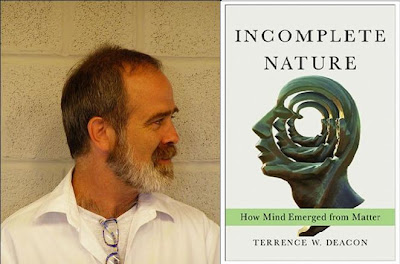
Incomplete Nature: How Mind Emerged from Matter

Image
Let me preface this by saying that Incomplete Nature is probably one of the most daring and original published scientific monographs I’ve ever read. Of course, it could also be one of the worst, it's actually impossible to tell. That said, I’ve had Terrence Deacon’s first book, The Symbolic Species , sitting on a shelf at my house for about five years now. I picked it up when I was a sophomore in college, at the second link of a five-year chain that went evolutionary biology → evolutionary psychology → cognitive neuroscience → philosophy of mind → consciousness → causality and information theory → oh-my-God-nothing-is-real. At the time I clearly wasn’t ready for the book, as I read about the first ten pages before putting it down. This was for two reasons. The first is that his books are long, dense, and convoluted, and his sentences tend to loop-the-loop back on themselves and self-cannibalize. This is certainly true for Incomplete Nature , which clocks in at over...