Posts

Showing posts with the label Neuroscience education

Neuroethics and the Emory Tibet Science Initiative

Image
I recently interviewed fellow Neuroethics Blog contributors Dr. Julia Haas and Dr. Gillian Hue about courses they taught during the summer at Tibetan Buddhist monasteries in South India as part of the Emory-Tibet Science Initiative (ETSI). Julia (who is a Postdoctoral Research Fellow in the Philosophy-Neuroscience-Psychology Program at Washington University) taught philosophy of science at Drepung Loseling Monastery in Karnataka, and Gillian (who is the senior program coordinator for the Emory University Initiative to Maximize Student Development , program associate in the Emory Neuroethics Program , and the Managing Editor for AJOB Neuroscience ) taught neuroscience at the Sera Jey Monastery in Bylakuppe. A neuroscience class at Sera Jey Monastery (Photo credit: Gillian Hue) The ETSI (part of the Emory-Tibet Partnership ) works to introduce science programs into the education of Tibetan Buddhist monks and nuns. Julia explained that “for the past six years they had a pilot program...
Teaching Tactics - Neuroethics in the Curriculum

Image
I made and abandoned several attempts at an opening sentence for this post and all of them included a deft way to bury the lead. The lead is this: I’m thrilled for two of my students whose video, Empathy and your Brain , was selected as one of the top submissions to the 2014 Brain Awareness Video Contest . Their video now has the chance to be selected as the fan favorite in the People’s Choice contest. But why was I burying it? I suppose I’ve become accustomed to integrating Neuroethics content and dialogue in courses that I teach, sometimes as part of the formal curriculum, but more often as implicit or hidden curriculum . Since Neuroethics courses are still not yet standard fare in most academic institutions, I generally don’t have an opportunity to explicitly test out some of the currently evolving creative techniques in Neuroethics education like those featured on NeuroethicsWomen Leaders teaching resources page . Instead, I often work the ideas and concepts into other mor...

Dare to be different: Defense of the research of sex differences

Image
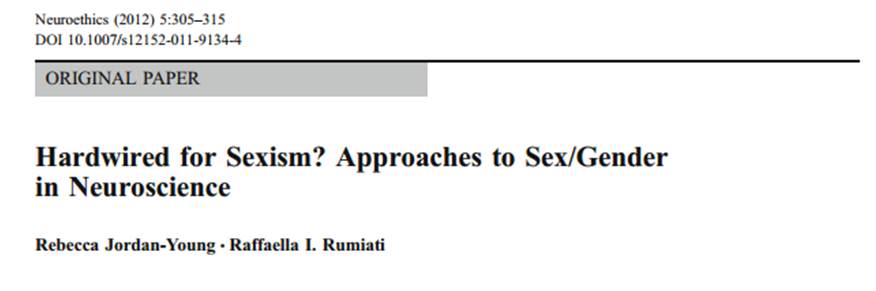
By Guest Contributor, Emory Neuroscience and Animal Behavior Graduate Student Katy Renfro In a recent article published in the journal Neuroethics , Dr. Rebecca Jordan-Young and Dr. Raffaella Rumiati argue that current research on sex differences is “both unscientific and far from politically neutral,” and should be abandoned. [6] This article reflects many of the current conversations on the ethical implications of researching sex differences, which have largely focused on how results of these studies can be misappropriated to support sexist agendas. I cannot argue against the legitimacy of these concerns, and as researchers, we must always be careful to present our findings in a balanced and accurate manner so as to better combat misinterpretations and misrepresentations of data. However, we must also keep in mind that just as science has the potential to influence social and political conversations, this is a bidirectional relationship, and politics also have the power to misinform ...

Joshua Greene: On Neuro-Improvement, Neuroenhancement, and Chekhov

Image
In their paper on the neuroenhancement of love and marriage , Savulescu and Sandberg argue that “there is no morally relevant difference between marriage therapy, a massage, a glass of wine, a fancy pink, steamy potion and a pill.” [1] But is this quite right? At a recent Emory Neuroethics Journal Club, participants discussed whether a distinction might be drawn between attending couples’ counseling and being exposed to oxytocin and, more broadly, whether there are differences between ‘traditional,’ conscious improvements and more immediate, pharmacological neuroenhancements. How should we go about comparing and contrasting these two processes? Since this issue has important implications for research, treatment, and education, I invited Dr. Joshua Greene to weigh in on the debate for the Neuroethics Blog. Dr. Greene is the John and Ruth Hazel Associate Professor of the Social Sciences in the Department of Psychology at Harvard University, and widely recognized for his experimental wor...

Neuroethics Debates by Emory Neuroscience Graduate Students

Image
In addition to writing blog posts about neuroethical issues provided to each group (as posted on the blog already), Emory neuroscience graduate students in the Neuroscience: Communication and Ethics Seminar held debates on neuroethical issues of their choosing. The idea behind the debates came from trying to develop better ways for the students to be engaged with concepts of neuroethics. Whereas discussions about neuroethical issues in a classroom often become discussions between the more vocal students and leave quieter students voiceless, the debate format would allow each student a set amount of time to voice their opinions. Course director Dr. Andy Jenkins arranged an instructional session for the class with Bill Newman, coach of the Barkley Forum, Emory’s award winning debate team. At the beginning of the semester, the instructors provided a handful of potential debate topics and allowed the students to contribute ideas that they came up with throughout the semester. ...

Third Installment: First Year Neuroscience Students at Emory Write about the Neuroethics of Sham Surgeries

Image
This year, Emory's First Year Neuroscience Graduate Students were asked to write a blog post for the Neuroethics portion of their Neuroscience and Communications Course. These posts will be delivered in 4 weekly installments, each week featuring a commentary on a different neuroethics piece. This is the third of four installments. This week, we feature blogs covering the following article: Experimental therapies for Parkinson's disease: Why fake it Nature 476, 142-144 (2011) http://www.frontiersin.org/integrative_neuroscience/10.3389/fnint.2011.00069/full Want to cite this post? Rommelfanger, K. (2011). Third Installment: First Year Neuroscience Students at Emory Write about the Neuroethics of Sham Surgeries. The Neuroethics Blog. Retrieved on , from http://www.theneuroethicsblog.com/2011/12/third-installment-first-year.html

Second Installment: First Year, Neuroscience Students at Emory Write About Neuroethics of the Brain and Violence

Image
This year, Emory's First Year Neuroscience Graduate Students were asked to write a blog post for the Neuroethics portion of their Neuroscience and Communications Course. These posts will be delivered in 4 weekly installments, each week featuring a commentary on a different neuroethics piece. This is the second of four installments. This week, we feature blogs covering the following article: Decline of violence: Taming the devil within us by Steven Pinker Nature 478, 309-311 (2011) SOURCE: M. EISNER CRIME JUSTICE 30 , 83–142 (2003) Want to cite this post? Rommelfanger, K. (2011). Second Installment: First Year, Neuroscience Students at Emory Write About Neuroethics of the Brain and Violence. The Neuroethics Blog. Retrieved on , from http://www.theneuroethicsblog.com/2011/12/second-installment-first-year.html

First Installment: First Year, Neuroscience Students at Emory Write About the Neuroethics of Schizophrenia and the Prodrome

Image
This year, Emory's First Year Neuroscience Graduate Students were asked to write a blog post for the Neuroethics portion of their Neuroscience and Communications Course. These posts will be delivered in 4 weekly installments, each week featuring a commentary on a different neuroethics piece. This week, we feature blogs covering the following article: Schizophrenia: The making of a troubled mind Nature 468, 154-156 (2010) Want to cite this post? Rommelfanger, K. (2011). First Installment: First Year, Neuroscience Students at Emory Write About the Neuroethics of Schizophrenia and the Prodrome. The Neuroethics Blog. Retrieved on , from http://www.theneuroethicsblog.com/2011/12/first-year-neuroscience-students-at.html

1 hot brain pic > 1k words?

Image
Pretty pictures of brains with some parts lit up: Do they convince us that scientific results are real? Do they convince us more than text or bar graphs? McCabe and Castel ask these questions in their 2008 article "Seeing is Believing" . (The above is not an actual figure. It was pirated mercilessly from a paper unrelated to this post by yours truly.) Last Wednesday, Dr. Karen Rommelfanger presented McCabe and Castel's paper at the first meeting of a new journal club hosted by the Neuroethics Program at the Emory Center for Ethics. Karen began by talking about how pervasive those pretty pictures of brains have become. Functional magnetic resonance imaging (fMRI) seems to be everywhere (a good introduction to how it works can be found here ). Some companies, such as Cephos ("The science behind the truth") and NoLieMRI (who make up for their lack of a snappy slogan with their rhyming name), claim to use fMRI scanners as giant lie detectors, while other companie...