Posts

Showing posts with the label future

“It is sometimes a sad life, and it is a long life:” Artificial intelligence and mind uploading in World of Tomorrow

Image
By Jonah Queen "The world of tomorrow" was the motto of the 1939 New York World's Fair Image courtesy of Flickr user Joe Haupt “One day, when you are old enough, you will be impregnated with a perfect clone of yourself. You will later upload all of your memories into this healthy new body. One day, long after that, you will repeat this process all over again. Through this cloning process, Emily, you will hope to live forever.” These are some of the first lines of dialogue spoken in the 2015 animated short film, World of Tomorrow .* These lines provide an introduction to the technology and society that this science fiction film imagines might exist in our future. In response to a  sequel , which was released last month, I am dedicating a post on this blog to discussing the film through a neuroethical lens. Plot Summary ( Note: the following contains spoilers for World of Tomorrow) Those lines are spoken to a young girl named Emily by one of her clones (a “third generatio...
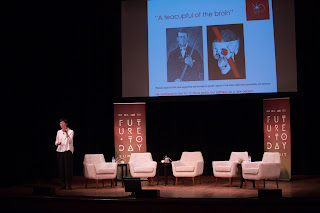
Future (Brain) Identities, Lost in Translation

Image
On December 6-7, 2016, the 92nd Street Y and the Future Today Institute successfully convened leading "research scientists, technologists, ethicists, policy makers, authors, elected officials, academics and artists to take stock of where we are—and where we are going."  On Dec 7, Emory's own Neuroethics Program Director, Dr. Karen Rommelfanger gave the closing keynote for the Future. Today Summit at the 92Y in New York. The topic of her talk was Future (Brain) Identities, Lost in Translation. A preview of her talk can be found below. In the full talk Dr. Rommelfanger discusses how neuronal signals are translated into actions of machines or even other brains. She concludes that many things have not changed with these technologies. Talking on the phone is probably still a better way to communicate than a brain to brain interface and frankly as far as powerful prosthetics go the most powerful brain prosthetic for memory continues to be the written word. Image cr...

A review of The Future of the Mind: The Scientific Quest to Understand Enhance, and Empower the Mind

Image
The Future of the Mind , authored by physicist Dr. Michio Kaku , explores how neuroscience might inform questions that philosophers have been debating for centuries: Do we have a soul? What happens after we die? Do we even have to die? And what would it take to produce a robot with human consciousness or emotions? To explore these questions, Dr. Kaku interviewed hundreds of scientists who are actively conducting ground breaking work in labs around the world, and from these conversations he made predictions on how these scientific findings would shape our future. The work that Dr. Kaku discusses, such as the latest advances in brain-computer-interfaces (BCI) for the disabled , 1 recording dream images with MRI machines , 2 or implanting memories in mice , 3,4 makes for a fascinating and engrossing read from start to finish. The Future of the Mind is at its best when taking readers through these areas of research and explaining the long-term significance, however many of the neurophi...