Posts

Showing posts with the label human rights

Neuroscience and Human Rights
Image
Last month, I had the privilege of attending the International Neuroethics Society Meeting in Washington, DC, made possible by a travel award from the Emory Neuroethics Program. This year's meeting featured panelists from diverse backgrounds: government, neuroscience, ethics, law, engineering, public health, and others. Each participant and attendee offered her unique perspectives on topical issues in neuroethics. As I listened to many thought-provoking presentations and discussions, a question kept arising in my mind: to what extent should scientists engage with issues of social justice if their research findings support changes in public policy? As a "war on science" continues to be waged by members of the U.S. Senate and Congress (see Senator Coburn's 2014 " Wastebook ," and the recent NPR Science Friday response by targeted scientists) and the American public lags in scientific literacy (A NSF report this year found that 1 in 4 Americans think the sun...

The 2014 International Neuroethics Society Annual Meeting

Image
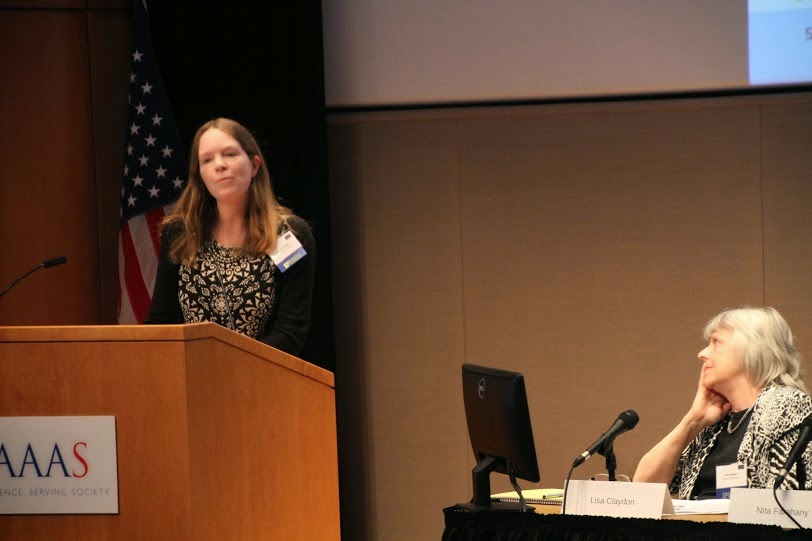
By Mallory Bowers On November 14, the International Neuroethics Society convened for its annual meeting at the AAAS building in Washington, D.C. I had the pleasure of attending and presenting at INS through the generous support of the Emory Neuroethics Program. The society is an interdisciplinary group of scholars - including lawyers, clinicians, researchers, and policy makers - and the 2014 agenda reflected this diversity in expertise. The conference opened with a short talk by Chaka Fattah, the U.S. representative for Pennsylvania’s 2nd congressional district. As a Philadelphia native, I was excited to learn that Congressman Fattah was an architect of the Fattah Neuroscience Initiative , which was an impetus for developing the Brain Research through Advancing Innovative Neurotechnologies (BRAIN) Initiative. Courtesy of Gillian Hue Discussion of the BRAIN initiative continued through the following panels, “The BRAIN Initiative & the Human Brain Project: an Ethical Focus” and “The...

We’re All Mad Here

Image
In the early 1970’s, eight people checked themselves into psychiatric hospitals throughout the United States, complaining of hearing voices. They were all admitted, and during their hospitalizations exhibited no unusual behavior and claimed to no longer be experiencing auditory hallucinations. After stays between 7 and 52 days in the institutions, the patients were discharged and given diagnoses of either schizophrenia or bipolar disorder. None of these people had any mental illnesses, and had, in fact, falsified their symptoms as part of an experiment conducted by psychologist David Rosenhan (who was himself one of the “pseudopatients”). The results of the study were published in a 1973 paper in Science titled “On being sane in insane places” . In the paper Rosenhan argues that it is difficult to distinguish between “normality” and “abnormality” when it comes to mental health, and that, once applied, the label of a psychiatric diagnosis can be so strong that all of an individual’s ac...