Posts

Showing posts with the label identity

Hot Off the Presses: The Neuroethics Blog Reader and Issue 8.4

Image
It is our pleasure to present you with two newly released publications: the second edition of The Neuroethics Blog reader and the 8.4 issue of the American Journal of Bioethics Neuroscience . Image courtesy of Flickr user Leo Reynolds . The second edition of The Neuroethics Blog reader features the most popular posts on the site, with topics ranging from human knowledge and its enhancement to mental illness to gut feminism. The reader includes posts from luminaries in neuroethics, scientific pioneers, undergraduates, graduate students, and established scholars from both within and outside the field of neuroethics.  The Neuroethics Blog , now in its 6th year of creating weekly publications, is pleased to present this reader to you and would like to thank our amazing blog editorial team: Sunidhi Ramesh (Volume Editor of this reader and Assistant Managing Editor), Carlie Hoffman (Managing Editor), Nathan Ahlgrim, Kristie Garza, and Jonah Queen (Supporting Editors and blog contributor...
The 2016 Kavli Futures Symposium: Ethical foundations of Novel Neurotechnologies: Identity, Agency and Normality

Image
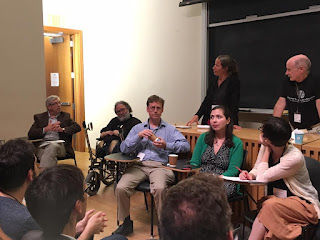
By Sean Batir (1), Rafael Yuste (1), Sara Goering (2), and Laura Specker Sullivan (2) Image from Kavli Futures Symposium (1) Neurotechnology Center, Kavli Institute of Brain Science, Department of Biological Sciences, Columbia University, New York, NY 10027 (2) Department of Philosophy, and Center for Sensorimotor Neural Engineering, University of Washington, Seattle, WA 98195 Detailed biographies for each author are located at the end of this post Often described as the “two cultures,” few would deny the divide between the humanities and the sciences. This divide must be broken down if humanistic progress is to be made in the future of transformative technologies. The 2016 Kavli Futures Symposium held by Dr. Rafael Yuste and Dr. Sara Goering at the Neurotechnology Center of Columbia University addressed the divide between the humanities and sciences by curating an interdisciplinary dialogue between leading neuroscientists, neural engineers, and bioethicists across three broad topic...

Submit your Abstract for the 2016 International Neuroethics Society Meeting in San Diego!

Image
Mark your calendars now for the 2016 International Neuroethics Society Annual Meeting taking place in San Diego, CA on November 11th and November 12th. This year the conference will feature 2 days of talks, networking opportunities, and poster presentations. Highlights from the meeting include Plenary Talks by Dr. Steve Hyman of the Stanley Center for Psychiatric Research and Dr. Walter J. Koroshetz from the National Institute of Neurological Disorders and Stroke (NINDS), while the two featured sessions on the 12th are entitled “Mind-Brain and the Competing Identities of Neuroethics” and “Deconstructing Therapeutic Neurotechnology 'Narratives': A Case Study of DBS for Depression.” Moderated by Dr. Eric Racine from the Institut de recherches cliniques de Montréal, “Mind-Brain and the Competing Identities of Neuroethics” will discuss three perspectives of neuroscience: empirical, speculative, and pragmatic, and these three views will be presented by Dr. Paul Applebaum , Dr. T...

When it comes to issues of identity and authenticity in DBS, let patients have a voice

Image
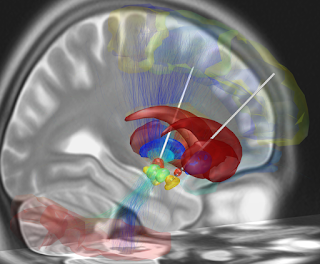
By Ryan Purcell Reconstruction of DBS electrode placement, image courtesy of Wikipedia Deep brain stimulation (DBS) is an extraordinarily popular topic in neuroethics. In fact, you could fill a book with all of the articles written on the subject just in AJOB Neuroscience alone (and the editors have considered doing this!). A special issue on the topic in AJOBN can be found here . Among the most widely discussed neuroethical issues in the DBS arena are concerns over the effects on patient identity and authenticity. But perhaps one perspective that has not been fully represented in the academic literature is that of the patients for whom this is actually their last hope to find a way out of a profound, debilitating and often years-long episode of depression. At February’s Neuroethics and Neuroscience in the News journal club, Dr. Helen Mayberg spoke passionately about the approach that led her team to attempt DBS for major depressive disorder (MDD), the ensuing media response, and ho...

Selfhood and ethics: Who am I and why does it matter?

Image
by Keenan Davis The following post is part of a special series emerging from Contemporary Issues in Neuroethics, a graduate-level course out of Emory University’s Center for Ethics. Keenan is a graduate student in Bioethics, whose work focuses on the use of virtue ethics and natural law to evaluate novel biotechnologies. He will be pursuing a PhD in the Graduate Division of Religion in the fall. What should I be doing with my life? Many approach this timeless question by considering first another: Who am I? For a wide range thinkers from Plato to Dr. Phil , we can only know what to do with ourselves when we truly know ourselves. Who we are determines and constrains how we ought to behave. For example, because my parents caused me to exist, I should behave towards them with a level of gratitude and love. Perhaps through a cause-and-effect dynamic, as a result of being their son, I should treat them respectfully. We will return to this example at the conclusion of our exploration. Hist...

Sexuality and "Alternating Gender Incongruity"

Image
In an article from the (somewhat) controversial journal Medical Hypotheses , researchers claim to have found a new neuropsychiatric syndrome called Alternating Gender Incongruity . A reporter from Scientific American commented on the article a few weeks ago, and the blog Neuroskeptic carried a short synopsis of the study the week before that. However, neither has commented on what I think are the two most fascinating (and perhaps troubling) aspects of this study. Image Credit: http://barbraquicksand.webs.com/ First, we have the way the researchers define sexuality. They say it is comprised of four facets: “gender identity (which sex you categorize yourself or see as others see you), sexual morphology, brain-based “sexual body image,” and sexual orientation (who you are attracted to).” [1] It is clear immediately that the term “sexuality” is used here to describe not sexual practice or identity, as it is generally used in my field, but to describe a large portion of what we call the s...