Posts

Showing posts with the label Riley Zeller-Townson

Just Neurons?

Image
Neuroessentialism is the belief that you , your mind, your identity, are essentially just your brain. It gets touted as an example of how science has triumphed, once again, over superstitions of the past - your soul hasn't died , it was just an illusion! Created by the brain. With memory, sensation, speech, and just about every other human attribute found to be located in one gyrus or another, it seems like there isn't anything left that could be outside of the brain. Francis Crick referred to this as the “astonishing hypothesis[1],” and while Stephen Pinker pointed out that for most neuroscientists this idea hardly warranted much astonishment[2], what might be more astonishing is how quickly the idea is bleeding out of the laboratory into popular media.  The basic philosophical foundations of this notion have been around for a long time (as mentioned on the [highly entertaining] podcast “ very bad wizards, ” we've known for a long time that when you remove the head, the mi...

Consciousness and Ethical Pain

Image
Imagine you find that a beloved uncle has received a terrible injury that leaves him paralyzed, but still totally aware of his environment - a condition known as locked in syndrome . Now imagine that a doctor comes to you with a miracle cure: a new experimental treatment will repair your uncle's damaged brainstem allowing him to regain control of his body. The catch, however, is that this procedure is extremely painful. It actually seems like it might be the most painful experience possible: fMRI scans reveal that all the brain regions that are active during extreme pain are activated during this (imaginary) procedure. And it lasts for hours. However, your uncle won't complain about the procedure because 1) he's paralyzed and thus can't voice his suffering, and 2) the experience of this miracle treatment will mercifully be forgotten once the procedure is over, so your uncle won't raise any complaint afterwards. While many of us would probably sign off on the procedu...

(Hypothetical) Crimes Against Neural Art

Image
We would expect that if there was any moral outrage to have over the treatment of cultured neural tissue, it would occur in an art gallery. Something about an art gallery sensitizes us to the well-being of critters we might not usually care about - as in the case of Garnet Hertz's Cockroach Controlled Mobile Robot  (a three wheeled robot about half the size of R2D2, driven by a Madagascar hissing cockroach) - and to cry out over events that we might otherwise willfully ignore or even accept as routine - as in Guillermo Vargas's infamous “ You Are What You Read ,” (where a starving dog was taken off the street and brought into a gallery) [1].  Instead, when neural tissue is given a robotic body and placed on display (sometimes remotely) in an art gallery, most responses seem to focus on the ambiguous nature of the works.  Artist Stephane Dumas wrote, referring to MEArt (a drawing robot controlled by a culture of rat brain cells), that “the public can experience the drawi...

Legal Pains

Image
When a friend accidentally burns themselves on a stove-top, their pain is usually very obvious - cursing, gesturing wildly, and even the explicit verbal pronouncement of "I am in pain."  It's also very clear from this display that their pain is viewed as a "bad" thing - they want it to stop, they will be more vigilant in the future to prevent it from happening again, and they very likely either want or even expect you to help out in these endeavors. Pain, while being a survival affirming biological phenomena, is (at least in this simple case here) also inherently ethical. We can then imagine that this same friend's nervous system might be manipulated (whether through mutation , injury, or pharmacological manipulation) to prevent them from feeling pain.  While we might initially be shocked at such a turn of events, we could be convinced of such a change if our friend stopped responding to usually painful stimuli (such as our villain the stove-top) with the sa...

Live Neurons in Art: Components or Collaborators?

Image
In his opening chapter of the biological art compendium “Signs of Life,”  Eduardo Kac  makes a particularly suggestive comment about the biological sciences in general.  I think this quote has even more significance to neuroscience specifically: “The extreme difficulty in dealing with very complex biological interactions leads to the simplified treatment of life processes as quantified data that exhibit statistical patterns.  In turn, this can lead to an objectification of life and a disregard for the subjects and their rights.”[1] From Zachary Weinersmith's Saturday Morning Breakfast Cereal This claim seems to echo Tom Wolfe's sentiment that scientific progress will lead to the death of the soul [2]: by reducing biological systems down to so many quantities and equations (all accurate within some statistical bounds), have we lost an important intuition about their intrinsic worth?  Is biology really just physical laws, with the same degree of moral importance ...

Pain in a Vat

Image
Previously on this blog I've discussed the case of cultures of living rat neurons, removed from their natural environment (the inside of the skull of a rat), and grown on top of an electrical interface that allows the neurons to communicate with robotic systems - effectively, we remove part of the rat's brain, and then give this reprocessed bit of brain a new, robotic body.  One of the stranger issues that pops up with this system is that it is extraordinarily easy to 'switch' between bodies in this situation. [1] For instance, I could easily write a computer program that creates a brief, pleasant sound reminiscent of raindrops every time the culture increases it's electrical activity.  Alternatively, the same burst of activity could be used to trigger an emotionless, electronic voice to say “Please help me. I am in pain.” While nociception (the low-level transmission of pain information) and unconscious reactions to pain both occur in the spine and peripheral nerv...

Who's responsible for 'free will?' Reminding you that all ideas were once new

Image
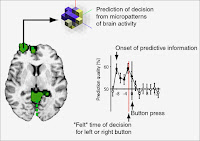
A figure adapted from Soon, Brass, Heinze and Haynes' 2008  fMRI study where a "free decision" could be predicted above  chance 7 seconds before it was consciously "felt."  Those  green globs could be thought of as the unconscious part of  your brain that is actually in control of your life.  Image  here , paper  here   As seen  previously on this blog , the notion of "Free Will" is a bit of a Neuroethics battleground. About 30 years ago, Dr. Benjamin Libet et. al.   published an experiment where the researchers were able to predict when human volunteers would press a button- a fraction of a second before the participants themselves realized they were going to do so.  And despite suggestions that the scientific method is breaking down , there is an entire cottage industry of scientists replicating Libet's result and finding more and more effectiv...