Posts

Two Internship Openings with Emory's Neuroethics Program for Spring 2013!
Image
NEUROETHICS INTERNSHIP OPENINGS Are you interested in the ethical and social implications of neuroscience? The Emory Neuroethics Program invites you to apply for a Neuroethics Internship. We are looking for up to two self-motivated, creative, and organized individuals who are interested in topics that fall at the intersection of neuroscience, society, and ethics. The Neuroethics Program is a community of scholars at the Emory University Center for Ethics who explore the ethical and social implications of neuroscience and neurotechnology. You can be part of that exciting team. The Center for Ethics at Emory is an interdisciplinary hub that collaborates with every school at Emory University as well as local universities and the private and public community. The Center for Ethics houses The American Journal for Bioethics Neuroscience, the premier journal in Neuroethics. The director of the Center for Ethics, Dr. Paul Root Wolpe, is one of the founders of the field of Neuroethics as well ...
Who's responsible for 'free will?' Reminding you that all ideas were once new

Image
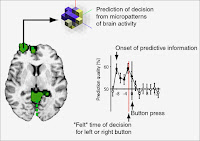
A figure adapted from Soon, Brass, Heinze and Haynes' 2008  fMRI study where a "free decision" could be predicted above  chance 7 seconds before it was consciously "felt."  Those  green globs could be thought of as the unconscious part of  your brain that is actually in control of your life.  Image  here , paper  here   As seen  previously on this blog , the notion of "Free Will" is a bit of a Neuroethics battleground. About 30 years ago, Dr. Benjamin Libet et. al.   published an experiment where the researchers were able to predict when human volunteers would press a button- a fraction of a second before the participants themselves realized they were going to do so.  And despite suggestions that the scientific method is breaking down , there is an entire cottage industry of scientists replicating Libet's result and finding more and more effectiv...

Uncovering the Neurocognitive Systems for 'Help This Child'

Image
In their article, “ Socioeconomic status and the brain: mechanistic insights from human and animal research ,” Daniel A. Hackman, Martha J. Farah , and Michael J. Meaney explore how low socioeconomic status (SES) affects underlying cognitive and affective neural systems. They identify and focus on two sets of factors that determine the relationship between SES and cognitive development: (1) the environmental factors or ‘mechanisms’ that demonstrably mediate SES and brain development; and (2) those neurocognitive systems that are most strongly affected by low SES, including language processing and executive function.  They argue that “these findings provide a unique opportunity for understanding how environmental factors can lead to individual differences in brain development, and for improving the programmes and policies that are designed to alleviate SES-related disparities in mental health and academic achievement” [1]. Neuroscience can tell us how SES may affect her brain. Can ...

Neurodiversity and autism: where do we draw the line?

Image
In April 2012, the Emory Neuroethics Program conducted an interview with Steven Hyman , the director of the Stanley Center for Psychiatric Research at MIT’s Broad Institute, where he expressed his belief that mental illnesses and developmental disorders should not be thought of as clear and distinct categories. He said that “classifications are, in the end, cognitive schemata that we impose on data in order to organize it and manipulate it…it's really not helpful to act like there's a ‘bright line’ in nature that separates the well from non-well.” Rather, he said, there are spectrums of behaviors, and disorders exist along them with differing degrees of severity. This idea of spectrum disorders is common in modern psychiatry, with a commonly known example being the autism spectrum. This approach groups similar disorders of varying levels of severity along a spectrum which also includes behaviors and emotions classified as normal. While the spectrum approach is often touted a...

The Future of Intelligence Testing

Image
Few people I know actually enjoy standardized tests. Wouldn’t it be great if technology could eliminate the need for bubble-in forms and Scantron sheets? How nice would it be to simply go in and get a snapshot of your brain to find out how smart you are? Imagine walking into the test center, signing on the dotted line, getting a quick scan, and walking out with your scores in hand, helping you gain admittance into a college or land your next job. No brain-racking questions, no tricky analogies, and no obscure vocabulary. Goodbye SAT, hello functional magnetic resonance imaging (fMRI). Image from  http://theturingcentenary.files.wordpress.com/2012/06/brain-functions.jpg      In the general, there have been two types of intelligence studies: psychometric and biological. Biological approaches make use of neuroimaging techniques and examine brain function. Psychometrics focuses on mental abilities (think IQ tests). Dr. Ian Deary and associates suggest that a greater over...

Staring into the Zombie Abyss

Image
By Guest Contributor Marc Merlin, Director of the Atlanta Science Tavern. In his excellent review of the recent Zombethics Conference, Ross Gordon covers the central themes discussed during its morning session: a hypothetical neuroanatomy of zombies that would account for their hostile behavior, the possibility of the existence of philosophical zombies, soulless humans walking among us and, finally, the always-vexing question of free will, as it concerns both zombies and us. Without a doubt these discussions have much to say about neuroscience and the philosophy of mind. What is less clear to me is what they have to say about ethics. They help us think more carefully about zombie behavior, but they offer little additional understanding of own our behavior, which is, after all, the grist for the ethics mill. The Piano Kill, via Zombieland The fact of the matter is that we are the ethical agents in the universe of human-zombie interactions. What motivates us and informs our behavior - c...

Doing Neuroscience, Doing Feminism: Interview with Dr. Sari van Anders

Image
Dr. Sari van Anders After attending the Neurogenderings Conference in Vienna, where participants debated whether it would be possible to conduct feminist neuroscience research, I decided it would be useful to interview an actual practicing feminist neuroscientist – and I knew just who to talk to. Dr. Sari van Anders is an Assistant Professor in Psychology and Women’s Studies at the University of Michigan. She earned her Ph.D. in Biological & Cognitive Psychology from Simon Fraser University. In her social neuroendocrinology lab at the University of Michigan, she conducts feminist neuroscience research on a variety of topics, with a principle focus on the social modulation of testosterone via sexuality, partnering/pair bonding, and nurturance. She has received grants from the National Institutes of Health (NIH) and the American Institute of Bisexuality and has published articles in Hormones and Behavior , Archives of Sexual Behavior , and Psychoneuroendocrinology , among others. ...