Posts

I know what you’re thinking…

Image
“I know what you’re thinking….” It’s a common saying and one that belies any functional capacity to predict another’s thoughts. Yet our drive to uncover arguably the most secretive and private form of information – thoughts – has led to major advances in the science of “reading one’s mind.” Current technologies are able to perform generally accurate predictions about robust neurologic phenomena such as distinguishing if an individual is looking at (or imagining) a face or a home (Haynes and Rees, 2006). However, as technologies advance it may well soon be possible to detect and identify more complex and covert thoughts – lies (Langleben et al., 2005) and even subconscious thought (Dehaene et al., 1998). With this ability, we must question the ethics surrounding the pursuit of this knowledge. Figure 3 from Haynes and Rees, 2006 The foremost concern with use of this technology is the right to privacy. At what length are we able to sidestep an individual’s basic right to privacy? If an in...

Brain reading and the right to privacy

Image
With advances in neuroimaging the ability to decode mental states in humans by recording brain activity has become a reality. In a review for Nature Neuroscience that is now six years old, John-Dylan Haynes and Geraint Rees detail how fMRI can be used to accurately predict visual perception. They explain that with advanced statistical pattern recognition, not only can the perception of broadly different visual inputs be differentiated, such as faces versus landscapes, but even the perception of subtly distinct objects, such shoes versus a chair, can be recognized. Further, fine details can also be distinguished, including image orientation, direction of motion, and perceived color. Indeed, the orientation of masked images can even be discriminated by activity in the primary visual cortex despite the subject being unable to consciously distinguish the orientation of the image. Decoding unconscious processing (from Haynes and Rees, 2006 ) While the power of fMRI and other imaging te...

Fourth and Final Installment: First Year Neuroscience Students at Emory Write about Neuroimaging and Decoding Mental States

This year, Emory's First Year Neuroscience Graduate Students were asked to write a blog post for the Neuroethics portion of their Neuroscience and Communications Course. These posts will be delivered in 4 weekly installments, each week featuring a commentary on a different neuroethics piece. This is the third of four installments. This week, we feature the final installment of student blogs covering the following article: Decoding mental states from brain activity in humans Nature Reviews Neuroscience 7 , 523-534 (July 2006) Unfortunately your browser does not support IFrames. Watch More News Videos at ABC | Technology News | Celebrity News

Hello! Anybody in there?

Image
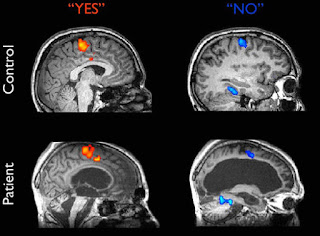
At what point can be say without a shout of a doubt that no one is left inside that lifeless corpse laying there motionless in that hospital bed? The first major problem we encounter when discussing “disorders of consciousness 1 ” is that we still don’t have a definitive definition of what consciousness even is. Is it a tangible mass in the brain? Does it light up in response to stimuli during a brain scan? We are still fighting these issues about people’s mental states and their level of consciousness yet we have no idea what that even is. It seems to be a losing battle that will only end in debate. Some are trying to go a step farther and implement modern technology into the better accessing a patient’s mental abilities and whether or not it is safe to define that as being in a vegetative state. Premotor cortex activity in a vegetative state ( Source ) The reasoning for challenging the standard operation of care is that, in 2008, it was reported that 43% of patients were diagnosed as...

Vegetative States

Image
Functional brain imaging techniques have become a versatile tool for peering into brain and how its activity can manifest as behavior. Nervous system injuries can leave people with varying degrees of functionality and capability. Disabilities can be of the mind such as the inability to perform cognitive tasks like math or impair memory recall or formation. Other injuries can be of the body such as in paralysis or quadriplegia. Unfortunately when it comes to brain injuries, the resulting symptoms are never easily quantifiable. Diagnosis of such patients is complicated by the fact that “There is as yet no universally agreed definition of consciousness and, to an even greater extent, no definition of ‘self-consciousness’ or ‘sense of self/being’“ (Owen and Coleman, 2008). It is thus no surprise that misdiagnosis resulting from brain imaging techniques are as high as 43% (Andrews et al. 1996, Childs et al. 1993). The progression of neuroimaging techniques being used clinically to diagnose ...

Ethics, Logic and Vegetative States on a First Date

Image
So, you’re on a first date and you’ve just finished discussing your favorite movies, how many siblings you have et cetera. The next natural topic of discussion will be “how do you feel about functional neuroimaging of the vegetative state?” Don’t be intimidated. Here are three guidelines to follow so that your discussion is intellectually stimulating and does not get stuck in a mire of cognitive biases and gaps in logic. fMRI Communication? ( Source ) Avoid the Availability Heuristic: Your date has most likely read over Owen and Coleman’s 2008 review of functional MRI’s ability to upgrade patients from vegetative states to non-behavioral minimally conscious states (Owen and Coleman 2008). It would be impossible for both of you not to think about the 43% chance of misdiagnosis if you’re in a vegetative state (Owen and Coleman 2008). Telling him/her that more recent studies have decreased these misdiagnoses to 41% probably won’t help (Schnakers 2009) It’s important to remember that just...

Third Installment: First Year Neuroscience Students at Emory Write about the Ethics of Neuroimaging of the Vegetative State

Image
This year, Emory's First Year Neuroscience Graduate Students were asked to write a blog post for the Neuroethics portion of their Neuroscience and Communications Course. These posts will be delivered in 4 weekly installments, each week featuring a commentary on a different neuroethics piece. This is the third of four installments. This week, we feature blogs covering the following article: Functional neuroimaging of the vegetative state Nature Reviews Neuroscience 9 , 235-243 (March 2008).